Hyundai BAYON Safety Features Explained: ADAS, 6 Airbags and Body Structure
Hyundai Motor India has revealed the safety package of the upcoming Hyundai BAYON ahead of its scheduled launch on 26 October 2026. The SUV will feature Hyundai SmartSense Level 2 Pro ADAS, six airbags as standard, a reinforced body structure and a range of active and passive safety technologies.
According to Hyundai, the BAYON will offer more than 80 advanced safety features, including over 35 features as standard across all variants. Its safety package also includes 23 advanced driver assistance functions, three radars and 12 parking sensors.
The company says the BAYON is engineered for five-star Indian safety standards. However, this statement should not be confused with an independently awarded five-star crash-test rating.
Here is a closer look at the Hyundai BAYON’s safety features, how its driver assistance systems work and what buyers should know before choosing the SUV.
Hyundai BAYON Safety Features at a Glance
| Safety feature | Details |
| Airbags | Six airbags as standard |
| Body structure | Global K Enhanced Platform |
| High-strength steel | 69% advanced multi-grade high-strength steel, as claimed by Hyundai |
| ADAS | Hyundai SmartSense Level 2 Pro |
| ADAS functions | 23 functions, according to Hyundai |
| Radar sensors | Three |
| Parking sensors | 12 |
| Electronic Stability Control | Standard |
| Hill-Start Assist Control | Standard |
| Tyre Pressure Monitoring System | High |
| ISOFIX child-seat mounts | Standard |
| Rear parking sensors | Standard |
| Surround View Monitor | Included in the announced safety package |
| Blind-spot View Monitor | Included in the announced safety package |
Hyundai has announced more than 35 standard safety features across the BAYON range. The table above highlights selected features rather than the complete safety equipment list.
Hyundai BAYON Body Structure and High-Strength Steel
A vehicle’s safety does not depend only on airbags and electronic assistance systems. The strength of its body structure and its ability to manage crash energy are also important.
Hyundai BAYON is built on the Global K Enhanced Platform. Hyundai says the SUV’s body structure uses 69% advanced multi-grade high-strength steel, incorporating hot-stamped steel, ultra-high-strength steel, advanced high-strength steel and high-strength steel.
These materials have different strength and forming characteristics. Their application in different parts of the vehicle helps engineers balance structural rigidity, crash protection and weight.

How does the body structure help during a collision?
Hyundai has highlighted several elements of the BAYON’s structural design:
- Hot-stamped components: These are used in critical areas, including the front apron, dashboard, rear floor and side reinforcements.
- Rear-floor side members: Hyundai says the hot-stamped components in this area are intended to improve rear-impact protection.
- Multiple load paths: These help distribute forces through different parts of the vehicle structure during a collision.
- Ring-type structure: This contributes to structural integrity around the passenger compartment.
- Dual-box construction: This forms part of the structural design intended to manage impact energy.
The purpose of these structural elements is to help absorb and distribute crash forces while reducing the risk of excessive intrusion into the passenger compartment.
However, the use of high-strength steel alone does not establish a vehicle’s crash-test performance. Actual results depend on the complete vehicle design and the outcome of standardised crash tests.
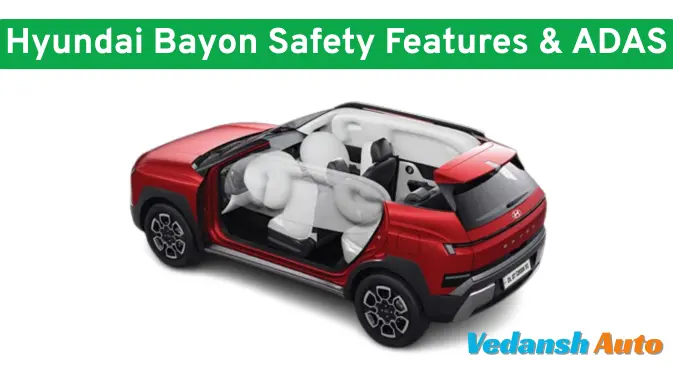
Six Airbags as Standard
Hyundai has confirmed that the BAYON will receive six airbags as standard across all variants.
Airbags supplement seatbelts by providing additional protection during certain types of collisions. Their effectiveness depends on factors such as the direction and severity of the impact, correct seatbelt use and the occupant’s seating position.
For buyers comparing SUV variants, standardising six airbags across the range is an important consideration because it means this key safety provision is not limited to a top-specification model.
Occupants should still wear their seatbelts on every journey. Airbags are designed to work with seatbelts, not replace them.
Standard Safety Features Across All Hyundai BAYON Variants
Hyundai says the BAYON will have more than 35 standard safety features across all variants. Its announcement identifies the following equipment.
| Feature | What it does |
| Six airbags | Provide supplementary occupant protection in certain collisions |
| Electronic Stability Control (ESC) | Helps the driver maintain control when the vehicle begins to lose stability |
| Hill-Start Assist Control (HAC) | Helps prevent the vehicle from rolling backwards when starting on an incline |
| Tyre Pressure Monitoring System (TPMS) | Alerts the driver to tyre-pressure conditions covered by the system |
| ISOFIX | Provides standardised mounting points for compatible child seats |
| Three-point seatbelts and reminders | Secure occupants and remind them to fasten their seatbelts |
| Rear parking sensors | Alert the driver to detected obstacles while reversing |
| Emergency Stop Signal (ESS) | Activates a warning signal under specified emergency-braking conditions |
| Roll-over sensor | Detects certain roll-over conditions and supports the vehicle’s relevant safety functions |
| Central locking | Provides a centralised door-locking function |
| Burglar alarm | Helps alert the owner to certain unauthorised-entry events |
| Headlamp escort function | Keeps the headlamps illuminated for a limited period after the vehicle is switched off, where applicable |
This is a selection of the features disclosed by Hyundai, not a complete list of all 35-plus standard features.
The company has also announced all-wheel disc brakes as part of the broader safety package. Buyers should check the final specifications and equipment list for their chosen variant when these are published.
Why are standard safety features important?
Standard equipment matters because a buyer should not have to move to a more expensive variant simply to obtain essential safety provisions.
For example, ESC can help correct certain losses of directional control, while TPMS can alert the driver to a tyre-pressure problem before it becomes more serious. Neither system eliminates all risks, but both can support safer vehicle operation.
The final variant-wise specification sheet will be important for identifying any additional safety equipment that is available only on selected versions.
Hyundai SmartSense Level 2 Pro ADAS Explained
One of the main highlights of the Hyundai BAYON is its SmartSense Level 2 Pro Advanced Driver Assistance System (ADAS).
Hyundai says the system includes 23 advanced driver assistance functions, supported by three radars and 12 parking sensors. The announced technologies cover collision warnings, automatic braking assistance, lane support, blind-spot monitoring, reversing assistance and cruise-control functions.
ADAS uses information from cameras, radar sensors and other vehicle systems to identify certain hazards and assist the driver. Depending on the function, the vehicle may provide a warning, apply braking assistance or offer steering support.
The following sections explain the key functions announced for the BAYON.
Forward Collision Warning (FCW)
Forward Collision Warning monitors the road ahead for certain potential collision risks. If the system detects a situation that meets its warning criteria, it alerts the driver.
This can be useful in traffic where the vehicle ahead slows down unexpectedly. However, the driver remains responsible for maintaining a safe following distance and responding to changing road conditions.
Forward Collision-Avoidance Assist (FCA)
Hyundai has announced several FCA functions for the BAYON:
- FCA-Car: Helps detect certain collision risks involving vehicles ahead.
- FCA-Pedestrian: Helps identify certain collision risks involving pedestrians.
- FCA-Cycle: Helps detect specified collision risks involving cyclists.
- FCA-Junction Turning: Assists in certain situations where a collision risk arises while turning at a junction.
- FCA-Direct Oncoming: Addresses certain collision risks involving oncoming vehicles.
Depending on the system and the circumstances, Forward Collision-Avoidance Assist can warn the driver and may apply braking assistance.
These functions can be particularly relevant on Indian roads, where traffic conditions may change quickly and pedestrians, two-wheelers and cyclists frequently share road space with cars.
Nevertheless, these systems have operating limitations. Detection and intervention may be affected by speed, visibility, road layout, weather and the movement of other road users.
Lane Departure Warning (LDW)
Lane Departure Warning alerts the driver when the vehicle appears to be leaving its lane unintentionally under conditions supported by the system.
It is designed to improve awareness, especially on roads with visible lane markings. It does not mean the driver can stop checking mirrors or monitoring the road.
Lane Keeping Assist (LKA)
Lane Keeping Assist can provide steering assistance when the system detects an unintended departure from the lane and its operating conditions are met.
The driver must continue steering and remain responsible for the vehicle. Lane markings that are faded, missing or difficult to identify can affect system operation.
Lane Following Assist (LFA)
Lane Following Assist is designed to help the vehicle follow the detected lane path in supported conditions.
It can reduce some of the effort involved in maintaining a position within a clearly marked lane. It should not be treated as autonomous driving or as a replacement for driver supervision.
Driver Attention Warning (DAW)
Driver Attention Warning is intended to alert the driver when the system detects certain indications of reduced attention.
It can serve as a reminder to concentrate on driving or take a break when needed. However, it cannot reliably identify every instance of fatigue or distraction.
Safe Exit Warning (SEW)
Safe Exit Warning is particularly relevant when parking beside busy roads.
The system is designed to warn occupants if it detects an approaching vehicle from behind when a door is about to be opened.
For example, this may help alert an occupant before opening a door into the path of a passing vehicle or two-wheeler.
The driver and passengers should still check their surroundings before opening any door.
High Beam Assist (HBA)
High Beam Assist can automatically manage the headlamp’s high-beam setting in supported conditions, helping the driver maintain visibility while reducing the risk of dazzling other road users.
Its operation depends on the system detecting relevant traffic and lighting conditions. Drivers must remain prepared to adjust the headlamps when required.
Leading Vehicle Departure Alert (LVDA)
Leading Vehicle Departure Alert is intended to notify the driver when the vehicle ahead begins moving after a stop, where the system detects the situation.
This can be useful in queues and traffic signals when a driver may not immediately notice that traffic has started moving again.
Blind-Spot Monitoring and Reversing Assistance
The Hyundai BAYON’s announced safety package includes several features designed to help drivers monitor areas that may be difficult to see using conventional mirrors.
Blind-spot Collision Warning (BCW)
Blind-spot Collision Warning alerts the driver when the system detects a vehicle in a monitored blind-spot area.
This can be useful before changing lanes on a multi-lane road. However, drivers must still check their mirrors and surroundings before moving into another lane.
Blind-spot Collision-Avoidance Assist (BCA)
Blind-spot Collision-Avoidance Assist is designed to help prevent certain collisions involving vehicles in adjacent lanes. Depending on the operating conditions, it may provide warnings or intervention.
It is an additional safeguard, not permission to change lanes without checking for other road users.
Blind-spot View Monitor (BVM)
The Blind-spot View Monitor displays a camera view of the relevant blind-spot area on the driver’s display when the system is activated under its specified conditions.
This additional view can help the driver assess nearby traffic, particularly before a lane change.
Rear Cross-Traffic Collision Warning (RCCW)
Rear Cross-Traffic Collision Warning alerts the driver to certain approaching vehicles when reversing out of a parking space or driveway.
For instance, a car parked between two larger vehicles may have limited visibility of traffic crossing behind it. A warning system can provide an additional indication of an approaching vehicle.
Rear Cross-Traffic Collision-Avoidance Assist (RCAA)
Rear Cross-Traffic Collision-Avoidance Assist builds on rear cross-traffic detection by offering intervention in certain situations where a collision risk is detected.
Its effectiveness depends on the system’s detection capabilities and operating conditions. The driver should reverse slowly and check the area around the vehicle.
Surround View Monitor and Parking Sensors
Parking assistance is another important part of the Hyundai BAYON’s announced safety package.
Surround View Monitor (SVM)
The Surround View Monitor combines camera views to provide a view of the area around the vehicle on the display.
This can help drivers judge their position in tight parking spaces, narrow streets and areas with nearby obstacles.
It is particularly useful when parking in urban locations where space is limited. However, camera views can have blind spots and may distort the apparent distance to an object. Drivers should use the system alongside direct observation.
Front and rear parking sensors
Hyundai has announced 12 parking sensors, along with rear parking sensors as part of the standard safety equipment.
Parking sensors alert the driver when the vehicle approaches detected obstacles. They can help reduce the risk of minor impacts during low-speed manoeuvres.
Sensors may not detect every object, particularly those that are small, low, narrow or outside their detection range. Drivers should not rely on warning sounds alone.
Highway Driving Assistance and Smart Cruise Control
The BAYON’s ADAS package also includes functions intended to support driving on highways and expressways.
Smart Cruise Control with Stop & Go
Smart Cruise Control with Stop & Go is designed to maintain a selected speed and following distance from a vehicle ahead in supported conditions. The Stop & Go function can assist in slowing down and resuming movement in certain traffic situations.
This may reduce the effort required in changing traffic conditions. The driver must remain attentive and be ready to brake or steer whenever necessary.
Navigation-based Smart Cruise Control
Hyundai has announced two navigation-based functions:
- NSCC-C: Navigation-based Smart Cruise Control Curve, designed to support speed management around certain curves.
- NSCC-Z: Navigation-based Smart Cruise Control Zone, designed to support speed management in specified road zones.
These functions use navigation information to support driving assistance in applicable situations. Their performance depends on the available map information, system settings and operating conditions.
Highway Driving Assist (HDA)
Hyundai’s announcement also refers to Highway Driving Assist as part of the BAYON’s highway-driving support package.
Highway Driving Assist combines supported driving-assistance functions to help with aspects of speed, following distance and lane positioning on suitable roads.
It is important to understand that these technologies do not make the vehicle self-driving. The driver must supervise the system continuously and remain ready to take control.
What Does Level 2 ADAS Mean for Buyers?
Level 2 ADAS refers to a category of driving assistance in which the vehicle can provide steering assistance and speed or braking assistance simultaneously under supported conditions.
However, the driver remains responsible for the driving task.
For Hyundai BAYON buyers, the announced Level 2 Pro package could be useful in several situations:
- Highway journeys: Cruise-control and lane-assistance functions may help reduce driving effort.
- Busy urban traffic: Collision warnings and certain braking-assistance functions may help alert the driver to hazards.
- Lane changes: Blind-spot warnings and camera views can provide additional information about nearby traffic.
- Parking: Surround View Monitor and parking sensors can help the driver judge available space.
- Reversing: Rear cross-traffic warnings and assistance may help identify certain approaching vehicles.
The actual benefit will depend on how well the systems work in real-world conditions, the quality of road markings, traffic behaviour, weather and driver understanding.
Before buying, customers should ask the dealership to demonstrate the available ADAS functions and explain their operating limitations.
Hyundai BAYON Engine and Transmission Options
Hyundai has announced a four-cylinder 1.5-litre MPi petrol engine for the India-spec BAYON.
The stated specifications are:
| Specification | Details |
| Engine | 1.5-litre MPi petrol |
| Maximum power | 115 PS |
| Maximum torque | 143.8 Nm |
| Manual gearbox | Six-speed manual |
| Automatic gearbox | Intelligent Variable Transmission (IVT) |
The engine and transmission details provide useful context for buyers evaluating the SUV. However, the final buying decision will also depend on the launch price, variant-wise features, fuel efficiency, ownership costs and the availability of the safety equipment they want.
Hyundai BAYON Launch Date and Booking Details
Hyundai Motor India has scheduled the BAYON’s launch for 26 October 2026.
According to the company’s announcement, bookings are open through Hyundai’s official website and authorised dealerships. The announced booking amount is ₹11,000.
Hyundai has stated that delivery timelines will be communicated at the time of launch.
Buyers should check the official website or contact a dealership for the latest booking terms, variant details, pricing and delivery information.
Conclusion
The Hyundai BAYON’s announced safety package combines a reinforced body structure, six standard airbags, electronic stability control, parking assistance and a broad suite of driver assistance technologies.
Its SmartSense Level 2 Pro ADAS package is one of the main highlights, with functions intended to support collision avoidance, lane keeping, blind-spot awareness, reversing and highway driving.
For buyers, the key consideration will be how these systems perform in practice, which features are available on each variant and whether independent crash-test results become available.
Hyundai’s claim that the BAYON is engineered for five-star Indian safety standards should be kept separate from an independently awarded crash-test rating. Once the SUV launches and its full variant-wise specifications are available, buyers will be better placed to assess its overall safety offering.
Frequently Asked Questions About Hyundai BAYON Safety
Does the Hyundai BAYON get six airbags?
Yes. Hyundai has announced six airbags as standard across all variants of the India-spec BAYON.
How many ADAS features does the Hyundai BAYON have?
Hyundai says the BAYON will offer 23 Hyundai SmartSense Level 2 Pro ADAS functions. The announcement also mentions three radars and 12 parking sensors.
What are the main safety features of the Hyundai BAYON?
The announced package includes six airbags, ESC, Hill-Start Assist Control, TPMS, ISOFIX mounts, rear parking sensors, Surround View Monitor, Blind-spot View Monitor and several collision-warning and driver-assistance functions.
Does the Hyundai BAYON have a five-star Bharat NCAP rating?
Hyundai says the BAYON is engineered for five-star Indian safety standards. However, BAYON has not been independently tested yet.
What is the Global K Enhanced Platform?
It is the platform on which Hyundai says the BAYON is built. Hyundai has highlighted its reinforced structure, use of multiple grades of high-strength steel and design features intended to manage crash energy and protect occupants.
Can the Hyundai BAYON drive itself with Level 2 ADAS?
No. Level 2 ADAS provides driving assistance under specified conditions, but the driver remains responsible for controlling and supervising the vehicle.
Does the Hyundai BAYON offer a Surround View Monitor?
Yes. Hyundai has included the Surround View Monitor in the announced safety package. Buyers should confirm its availability and exact specification for their chosen variant.
When will the Hyundai BAYON launch in India?
Hyundai has scheduled the launch for 26 October 2026. The company has announced a booking amount of ₹11,000, with delivery timelines to be communicated at launch.